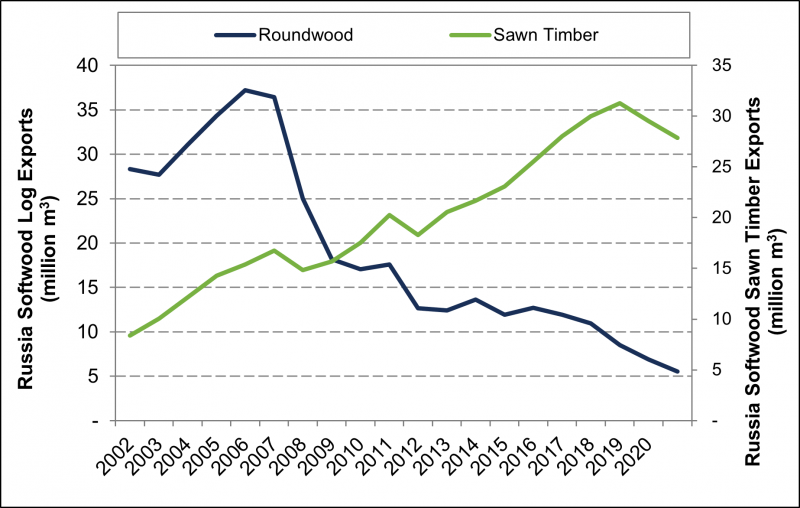

Russian sawn timber exports, which have been sanctioned by the EU along with other wood products since July 10, were up 3.4% in the January-June period. Sources in Russian Kommersant news daily pointed out that while Russian companies are trying to adjust their export focus to the Middle East and Asia, experts predict a double-digit decline in exports of products such as pellets, sawn timber and plywood.
Shipments abroad by Russian timber exporters rose 3.4 percent to 13.4 million cubic meters in the first half of the year. The relevant Russian statistics department told the media that demand from Russia’s friendly countries increased by 8%, laying the foundation for export growth.
Timber exports to friendly countries accounted for 72% (9.6 million cubic meters) of Russian timber exports. China imported more than 6.5 million cubic meters, about half of total shipments. Uzbekistan came in second with more than 976,000 cubic meters of imports.
Meanwhile, unfriendly countries, mainly the European Union and the United States, reduced their imports by almost 7% to 3.8 million cubic meters. One of the countries with the largest number of imports is Singapore, which imported about 650,000 cubic meters of wood products, and Singapore did not even enter the top ten importing countries before.
As mentioned above, most market participants believe that the trend of import growth in the first half of the year will not continue in the remaining months of 2022, on the contrary, a sharp decline is inevitable.
This is mainly due to the fact that EU sanctions on imports of Russian timber and its main processed products came into effect on July 10. The only exceptions to the sanctions are seating furniture, prefabricated building structures, methyl alcohol, pulp (except semi-chemical and chemi-mechanical pulp) and paper (except kraft and kraft).
In addition, the United States imposed a 35% tariff on imported Russian lumber from the end of July, but this does not affect plywood, round wood, newsprint, pulp and hygiene products. Industry insiders pointed out that these companies are bracing for a sharp deterioration in performance, as exports to unfriendly countries have so far continued, albeit complicated by logistical problems.
Earlier, Iran, Turkey, Egypt and some other Middle Eastern and Asian countries were ready to become transport hubs, both exporting Russian goods to third countries and importing goods to Russia from unfriendly countries.
But experts are more pessimistic. Russia expects a clear, double-digit percentage decline in exports of forest products, including logs, pellets, sawn timber and plywood. Logging volumes are likely to decrease as the demand for logs from lumber mills will fall. Production and exports of sawn timber may also decline, but less so than higher value-added products.
The post Russian timber, timber product exports likely to see double-digit decline in second half appeared first on Global Wood Markets Info.